Board-on-Board, Shadow Box or Spaced Picket: Choosing a Wood Privacy Fence
The style you pick decides how much privacy you get, how the fence handles wind, and what your neighbor sees.
October 1, 2026 · 4 min read
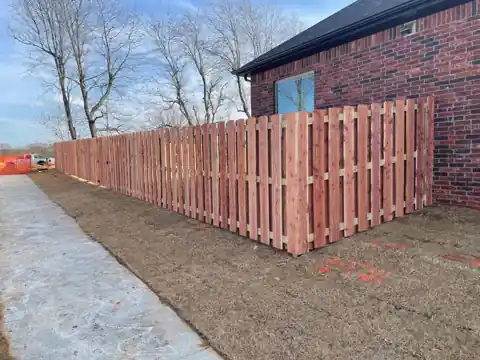
Walk the fence lines in any Northwest Arkansas neighborhood, from a new build in Bentonville to an older lot in Springdale, and you'll see the same three wood styles over and over. From the street they look much alike. Up close they behave very differently, and the choice shapes how private your yard feels, how the fence handles a windy spring afternoon, and what the back of it looks like to the people next door.
Board-on-board: no visible gaps
Board-on-board uses overlapping pickets, so there are no visible gaps between boards. Each picket sits over the seam between the two beneath it. That overlap is the whole idea. Wood shrinks as it dries, and the seams open a little, but the second layer still blocks the line of sight. If your yard backs up to a busy road, a pool deck or a neighbor's patio, this is the style that keeps its privacy year after year.
The tradeoff is material. Overlapping boards use more lumber per foot of fence than the other two styles, and you'll see that in the estimate. A solid wall of boards also catches more wind than an open design, which is why what's holding the fence up matters. Privacy Fence offers PostMaster steel posts, a hidden design that keeps the natural wood look while resisting rot, shifting and long-term ground moisture.
Shadow box: the good neighbor fence
A shadow box fence alternates the boards from one side of the rails to the other. Because pickets sit on both faces, it looks finished from both sides, which is why it gets called a Good Neighbor Fence. You get a clean face and so does the lot next door, with no bare rails or nail heads staring at anyone.
Air passes through the gaps behind the boards, so shadow box handles wind better than a solid wall. Privacy is a little lower, since standing at a sharp angle can give you a glimpse through. For most backyards the goal is to hide the patio and keep a dog in, and shadow box does both. Privacy Fence has built it in cedar along new construction and in pine as a screen to hide utilities.
Spaced picket: partial privacy on purpose
Spaced picket leaves a deliberate gap between boards. It hides detail rather than shape, which suits a front yard, a garden edge or a property line where you want a clear boundary without a wall. It uses the fewest boards of the three, and a cedar spaced picket across a front lawn looks light and finished at the same time.
Pine or cedar
Pressure-treated pine is durable and budget-friendly, and it's what Privacy Fence uses for rails and posts unless a customer asks for something else. Cedar costs more, but it has natural resistance to rot and insects, and you can stain it or let it weather naturally. The company stocks both eastern (native) cedar and western cedar.
Any wood fence moves as it takes on and loses moisture, and pine moves more than cedar. That's a drawback of the material, not a defect in the build, and it's worth knowing before you choose. We cover it in more detail in our article on staining a new wood fence.
One more difference shows up at the property line. Most fences have a finished side and a side that shows the rails, so think about which face your neighbor will see. A shadow box looks finished from both directions, while the other styles usually put the rails on one side. Ask the estimator how the fence will be oriented before the crew starts.
A quick way to match style to yard
- Board-on-board: no visible gaps, the most privacy, the most lumber.
- Shadow box: finished on both sides, lets wind pass, slightly less privacy at sharp angles.
- Spaced picket: open look, partial privacy, a good fit for front yards.
- Pine: durable and budget-friendly, moves more as it dries.
- Cedar: natural rot and insect resistance, stained or left to weather.
Upgrades worth pricing
Cap and trim gives a wood fence a finished top edge and a framed look, and it shows up on a lot of the cedar fences Privacy Fence builds in Bentonville, Bella Vista and Rogers. You can also ask about horizontal boards, 3-rail and 4-rail styles, and 8-foot heights. Height limits and neighborhood rules differ from town to town, so tell the estimator about any HOA before you fall in love with a design. Once a project is awarded, Privacy Fence handles the permit process.
Seeing the styles in person helps more than any description. Call (479) 751-7894 for a free on-site estimate, or use the online design tool to draw your fence on a satellite map of your yard and get an instant quote.
Privacy Fence, Inc, (479) 751-7894
Call (479) 751-7894More articles
Why Fence Gates Sag, and How a Gate Should Be Built
Most sagging gates were doomed by the post they hang from, not the gate itself.
Building a Fence on a Slope in Northwest Arkansas
On a hillside lot, the difference between a good fence and a gappy one is how it meets the ground.