When to Stain a New Wood Fence: Moisture, Pine and Cedar
The right day to stain a new fence is set by the wood's moisture content, not the calendar.
October 1, 2026 · 3 min read
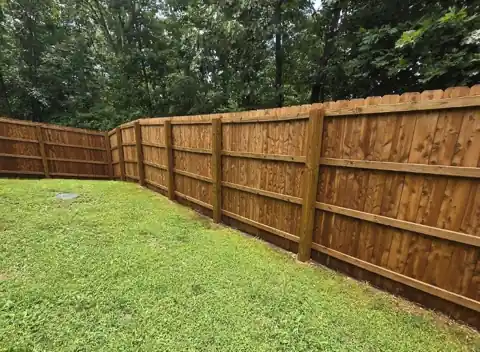
Moisture content decides when a new wood fence can be stained, and the number Local Stain of Northwest Arkansas works from is 14 percent. Stain applied to wood that's wetter than that can't soak in properly, so it sits on the surface, peels, and leaves you with a fence that looks worse than if you'd left it bare.
Why new wood is wet
Lumber doesn't come out of the mill dry. Pressure-treated pine in particular is soaked with preservative during treatment, and it holds a lot of that water when the boards go up. Cedar is a different story, but it also needs time to settle after it's cut and delivered. As the fence sits in the Arkansas sun, the boards give up moisture and shrink.
A moisture meter reads this number directly, which is better than guessing from how the boards look. Local Stain's rule is to stain once the moisture content is 14 percent or below. Your fence will tell you when, if you measure instead of waiting for a certain number of weeks.
Why pressure-treated pine warps
If you've seen a new pine fence twist or cup as it dried, you've seen this in action. Privacy Fence points to a change in treatment: the EPA phased out CCA about 20 years ago, and the replacement treatments stabilize pine less. The boards move more as they dry, and no stain stops that. A stain can slow the swings in moisture afterward, but it doesn't flatten a board that has already curled.
Pine is still a durable, budget-friendly material, and Privacy Fence builds a lot of it. The point is to expect some movement. Nails matter too, and the company uses hot-dipped ring-shank or screw-shank galvanized nails so boards stay fastened as they move.
Transparent or semi-transparent
Local Stain uses Wood Defender, an oil-based stain, in two types. Transparent lets the grain and the natural color of the wood show through with only a tint. Semi-transparent carries more pigment, so it adds more color, and it hides variation between boards better. On cedar, many owners choose transparent to keep the grain. On pine, semi-transparent often gives a more even look.
Their sample colors show how much range there is. Cedar Tone and Desert Sand go on eastern cedar, and Leatherwood and Dark Sierra go on western cedar. Privacy Fence's staining page shows stained cedar runs in those colors, including a dark-stained cedar fence on black posts.
Oil-based stain also soaks into the wood rather than forming a film on top. That matters on a fence, where sun, rain and temperature swings in Northwest Arkansas hit every board from both sides. A coating that sits on the surface tends to crack and peel as the wood moves, while stain that has soaked in simply fades and can be refreshed later.
Or let cedar weather
Cedar can be stained or left to weather naturally. Unstained, it fades to a silvery gray over time. Some people love that, and others want to hold the warm color they saw on day one. Neither is wrong, but it is a decision to make before the fence goes up rather than after, because a fence that has already weathered gray needs more preparation before it takes stain evenly. If you're not sure, ask to see the sample colors against the wood you're considering.
How the process works with Privacy Fence
Privacy Fence doesn't stain fences itself. Staining is handled by Local Stain of Northwest Arkansas, which Privacy Fence calls its trusted family company, and it's scheduled and billed separately from the fence build. That separation is useful, since the stain crew arrives when the wood is ready, not when the last picket goes up.
- Tell the estimator you want stain. Alan can include a staining estimate while he's quoting your new fence.
- Choose wood with the finish in mind: cedar for natural color, pine if budget comes first.
- Pick transparent or semi-transparent and a sample color.
- Wait for the wood to reach 14 percent moisture or below, then schedule Local Stain.
Ready to talk it through? Call Privacy Fence at (479) 751-7894 for a free on-site estimate, and ask about staining while you're at it. You can also use the online design tool to draw your fence on a satellite map and get an instant quote.
Privacy Fence, Inc, (479) 751-7894
Call (479) 751-7894More articles
Board-on-Board, Shadow Box or Spaced Picket: Choosing a Wood Privacy Fence
The style you pick decides how much privacy you get, how the fence handles wind, and what your neighbor sees.
Why Fence Gates Sag, and How a Gate Should Be Built
Most sagging gates were doomed by the post they hang from, not the gate itself.